
Falls in the bathroom are among the most common causes of household injuries worldwide. Whether due to slippery wet tiles, smooth porcelain surfaces, or the physical demands of transitioning from a seated to a standing position, the bathroom presents significant spatial challenges for seniors, individuals recovering from surgical procedures, and young children alike. Traditionally, resolving these safety concerns meant hiring professional contractors, drilling permanent holes into expensive ceramic tiles, and running the risk of permanent property damage—a major barrier for renters and budget-conscious homeowners.
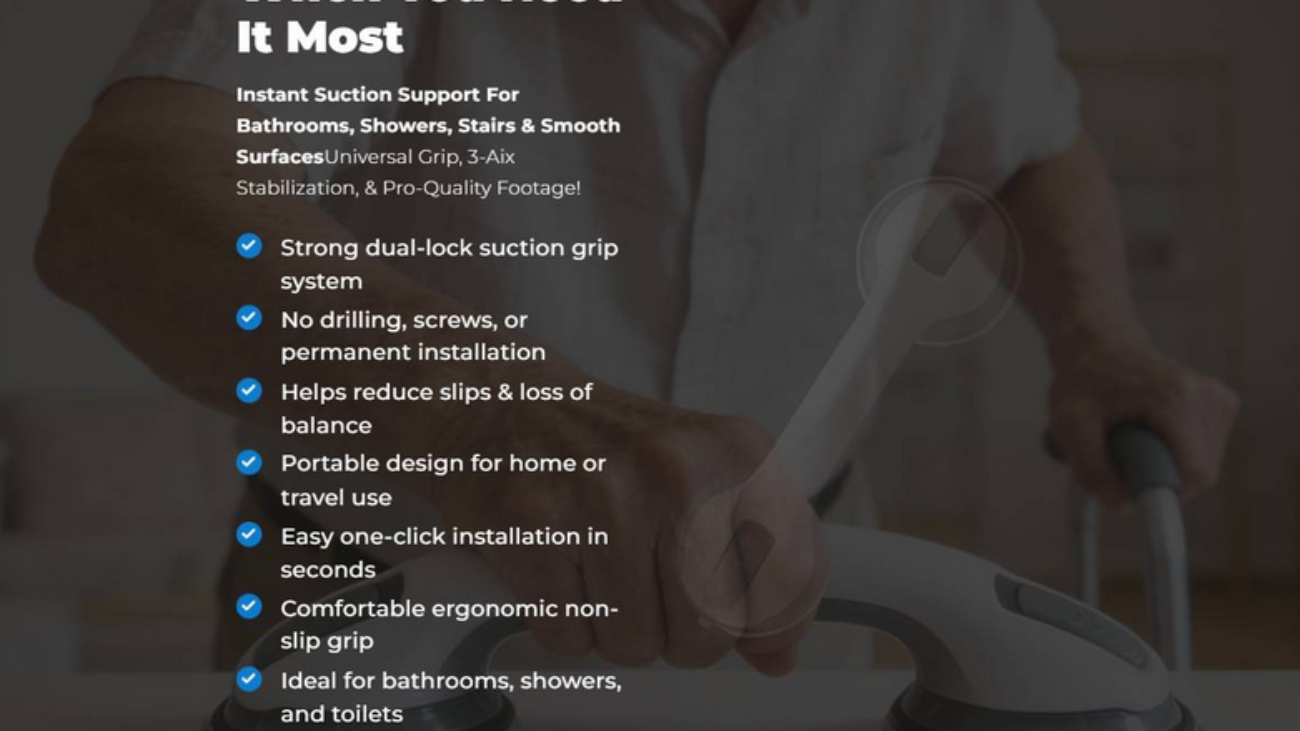
The UltraGrip Assist changes this dynamic entirely. This advanced portable safety handle offers structural support, immediate stabilization, and absolute peace of mind without a single screw, drill bit, or permanent alteration to your living space. Engineered with dual-locking heavy-duty suction mechanics, it provides an uncompromising, rock-solid grip on a wide array of smooth, non-porous surfaces.
This comprehensive guide breaks down the core technologies, practical applications, installation steps, maintenance protocols, and safety standards behind this bathroom assistance device. Read on to discover how this compact, budget-friendly innovation can transform your daily self-care routine into a risk-free, completely independent experience.
What Is the UltraGrip Assist Bathroom Handle?
The UltraGrip Assist is a premier medical-grade, tool-free portable safety rail designed specifically for wet environments and smooth-surface installations. Measuring an optimized 11.6 by 3.8 inches, it features an ultra-resilient composite frame flanked by two engineered industrial-strength rubber vacuum discs.
Unlike standard plastic handles that rely on basic mechanical friction, this device uses structural air pressure differentials created by dual integrated toggle levers. When pressed against an airtight wall and locked into position, the internal mechanisms exhaust ambient air from beneath the high-grade rubber pads. This forms an exceptional, airtight vacuum seal capable of bearing the heavy physical strain associated with standing up, sitting down, and sudden slips.
Core Architecture and Specifications
To understand why this safety rail outperforms generic market alternatives, it helps to analyze its physical dimensions and technical structural engineering:
Total Exterior Length: 11.6 Inches (Provides an ideal hand span for standard adult physiology).
Total Deep Clearance Height: 3.8 Inches (Ensures ample clearance room for thick fingers or gloved hands to wrap around completely without scraped knuckles).
Chassis Composition: High-density, impact-resistant ABS engineered thermoplastic.
Base Vacuum Elements: Dual independent 3.7-inch vulcanized rubber pads featuring deep-lip outer seals.
Locking Mechanism: Heavy-duty, independent dual-lever toggle assemblies.
Surface Interface Comfort: Textured, molded anti-slip grooved handle patterns along the inner grip core.
(Note: While a fuel cell highlights pressure management, the physical structural balance of pressure in a dual-vacuum grab bar relies on similar airtight engineering principles to prevent atmospheric failure.)
Key Features and Mechanical Design
What sets this safety bar apart from primitive, old-generation suction devices is its deliberate, highly methodical material composition and mechanical layout. Every single curve, groove, and internal component has been optimized to handle high moisture, frequent shifts in load weight, and the physical degradation commonly caused by humid bathroom environments.
Industrial-Strength Dual-Lock Vacuum System
The fundamental baseline of the device’s reliability is its dual-locking lever architecture. Cheaper suction devices rely on a simple twist mechanism or a singular large cup. If a microscopic structural defect or a small piece of dust breaks the seal on a single cup, the entire device immediately detaches, causing a potentially catastrophic fall.
This device addresses that single point of failure by utilizing two entirely distinct, isolated dual-lock assemblies. Each cup works as an autonomous vacuum system. Even if one side experiences a slow micro-leak over weeks of continuous use, the opposite cup provides a redundant margin of structural safety. The mechanical levers are constructed with heavy internal hinge-pins that amplify manual downward pressure, enabling people with mild arthritis or limited hand strength to lock the device firmly into place with minimal physical exertion.
High-Traction Ergonomic Anti-Slip Handle
Wet hands covered in soapy water have virtually zero friction coefficient against standard glossy plastic or polished chrome handles. A smooth grab rail can become just as hazardous as a slippery floor if your hand slides off during a fall.
To prevent this issue, the underside of this handle features a specialized, textured anti-slip grip zone. This area is physically molded into the internal curve of the handle, utilizing alternating rows of raised structural ribs. These ridges displace surface water and soap film, creating high-friction contact points directly with your skin. The ergonomic layout perfectly mirrors natural finger placement, allowing you to establish a secure grip instantly without having to squeeze with painful force.
Zero-Damage, Tool-Free Installation Framework
Permanent, screw-in safety bars pose significant deployment challenges. For renters, drilling into bathroom walls is a direct violation of lease terms that can result in the forfeiture of security deposits. For homeowners, drilling through heavy porcelain or slate tiles requires specialized diamond-tipped drill bits, precise measurements, and the perpetual risk of cracking expensive masonry. Furthermore, if the position of a permanent bar proves uncomfortable, removing it leaves behind unsightly, difficult-to-patch holes that expose the sub-wall to hidden water damage and mold growth.
This portable alternative completely bypasses these physical and structural limitations. It requires absolutely no hardware, anchors, power drills, or chemical adhesives. You simply place it exactly where you need it, flip the levers down, and begin using it immediately. If the placement needs to be adjusted, it can be uninstalled in seconds without leaving a single mark, scuff, or sticky residue behind.
Who Benefits Most from a Portable Safety Handle?
While primarily marketed as an assistive medical aid, the utility of a high-strength, tool-free temporary grab rail spans a vast demographic of users with varying mobility levels, physical conditions, and living arrangements.
+---------------------------------------------------------------------------------------+
|                                TARGET DEMOGRAPHICS & USES                             |
+------------------------------------+--------------------------------------------------+
| Seniors / Aging in Place           | Maintains bathroom autonomy & prevents slips.     |
+------------------------------------+--------------------------------------------------+
| Post-Op & Injury Recovery          | Temporary support during healing (hips/knees).   |
+------------------------------------+--------------------------------------------------+
| Frequent Travelers / Renters       | Non-destructive, packs flat in standard luggage. |
+------------------------------------+--------------------------------------------------+
| Toddlers & Small Children          | Low-height leverage for stepping into high tubs. |
+------------------------------------+--------------------------------------------------+
Seniors and Individuals Aging in Place
Maintaining personal independence and bodily autonomy is a primary goal for aging seniors. Needing assistance to use the toilet or step into a bathtub can be emotionally challenging, yet unassisted bathrooms are highly dangerous zones for older adults experiencing age-related inner-ear balance degradation, muscle atrophy, or bone density loss. Installing this non-permanent safety device provides the exact physical support needed to complete transitions independently, allowing seniors to safely manage their daily personal hygiene routines.
Post-Operative Patients and Rehabilitation Support
Following orthopedic surgeries—such as total hip replacements, knee reconstructions, or spinal procedures—patients face severe movement restrictions for weeks or months. During this recovery phase, maintaining balance and keeping weight off the healing limb is critical. However, a permanent safety rail is rarely desired or needed once the patient fully heals. A heavy-duty, temporary suction rail provides structural support precisely when it is required most, and can be easily removed and stored in a closet once full physical rehabilitation is achieved.
Renters and Apartment Dwellers
Many multi-family residential leasing agreements strictly prohibit structural modifications to bathrooms. Tenants are often left with zero viable options for installing permanent safety frames. Because this device relies solely on atmospheric pressure differentials rather than mechanical fasteners, it provides renters with a highly reliable way to protect themselves without violating lease terms or causing structural damage to the rental property.
Jet-Setters and Frequent Travelers
Hotel rooms, vacation rentals, and cruise ship cabins rarely offer universally accessible bathroom designs unless explicitly requested well in advance. For people who live with chronic mobility conditions, traveling can be highly stressful due to unfamiliar, slippery bathroom layouts. Thanks to its lightweight composite body and compact footprint, this portable handle packs easily into standard luggage, allowing you to carry reliable stability and peace of mind to any destination worldwide.
Comprehensive Step-by-Step Installation Guide
To guarantee the highest degree of structural stability and physical security, the handle must be deployed with strict adherence to proper surface preparation and sealing protocols. Vacuum mechanics depend entirely on creating a perfect, airtight seal. Following these steps carefully eliminates the risk of premature suction failure.
Step 1: Surface Verification and Selection
Before attempting to attach the device, you must carefully analyze the composition of the intended wall surface. The suction cups require a 100% smooth, non-porous material to maintain vacuum integrity.
Approved Surfaces: Large-format glazed ceramic tiles, smooth polished porcelain, structural glass sheets, clear fiberglass shower enclosures, and polished acrylic surfaces.
Prohibited Surfaces: Textured tiles, natural split-slate stone, porous unsealed marble, painted drywall, wood paneling, wallpaper, and any surface featuring raised decorative patterns or mosaics.
The Golden Rule of Placement: The entire surface of both suction pads must rest completely on a single flat surface. Never position a suction cup over a grout line. Grout lines are highly porous and will slowly leak air into the vacuum chamber, causing the device to lose suction and detach.
Step 2: Deep Cleaning the Wall and Pads
Any invisible oily film, soap scum buildup, mineral scaling, or stray hair beneath a suction cup will compromise the micro-seal, allowing ambient air to seep in over time.
Wash the selected area of the wall thoroughly using a high-grade degreasing soap, isopropyl alcohol, or a specialized residue-free bathroom tile cleaner.
Rinse the area with hot water to remove all soapy residues.
Dry the wall surface completely with a lint-free microfiber towel.
Wipe down the black rubber suction faces of the handle with a damp cloth to remove any transit dust, and dry them thoroughly.
Step 3: Positioning and Applying Pressure
With both flip levers raised into their vertical, unengaged positions, hold the handle firmly by its central grip.
Align the device horizontally or vertically on your prepared wall, ensuring both suction discs are clear of grout lines or surface blemishes.
Press the entire device firmly against the wall surface with substantial forward body weight. This manually forces out the vast majority of the air trapped beneath the rubber pads.
Step 4: Activating the Dual-Lock Levers
While maintaining consistent, firm forward pressure against the wall with one hand, use your free hand to depress the plastic locking levers.
Push each lever down flat against the housing until it clicks securely into place. You should feel a distinct, firm mechanical resistance as the internal linkages pull the center of the rubber pad inward, creating a powerful internal vacuum.
Visually inspect the levers to confirm they are sitting entirely flush with the outer framework of the device.
Step 5: Pre-Load Integrity Testing
Never put your full weight onto any suction assist handle immediately after installation without executing a manual pre-load safety test.
Grasp the handle firmly and pull it vigorously from side to side, then up and down.
Apply direct outward pressure to confirm the suction cups are holding firm.
If the device shifts, slides, or wiggles even slightly, release both levers immediately, clean the surface again, and repeat the installation process from Step 1.
Critical Maintenance, Inspection, and Safety Rules
Suction-based safety devices are not “install-and-forget” products. Because ambient temperature changes, relative humidity shifts, and everyday physical strain can cause micro-movements, maintaining safe operation requires basic routine maintenance and regular safety checks.
The Essential Daily Push-Test Routine
Before using the handle each day, develop the habit of performing a brief safety inspection. Simply give the handle a firm structural tug to ensure the vacuum seal remains fully intact. This five-second check is the single most effective way to prevent accidental slips caused by an overlooked micro-leak.
Periodic Reinstallation Protocols
No suction cup device can hold a vacuum indefinitely on a atomic level. Over weeks of continuous exposure to hot steam, cold air, and physical pulling forces, trace amounts of air will slowly pass through the microscopic pores of even the best rubber components.
To guarantee absolute safety, it is highly recommended to completely release, clean, and reinstall the handle at least once every two to three weeks. This routine reset clears away any soapy buildup around the edges of the cups and restores the internal vacuum to its maximum holding capacity.
Crucial Safety Limitations: Balancing vs. Full Weight Bearing
It is vital to understand the structural role of a portable suction handle within a home safety layout. This device is engineered as an assistive balance aid—not as a permanent, full-weight-bearing industrial crane.
+---------------------------------------------------------------------------------------+
|                                  PROPER USAGE SPECTRUM                                |
+---------------------------------------------------------------------------------------+
| [CORRECT] Steadying balance while stepping over high tub walls                        |
| [CORRECT] Providing leverage when transitioning from a seated position                |
| [CORRECT] Stabilizing the body during minor slips on wet bathroom tiles              |
|                                                                                       |
| [INCORRECT] Suspending your entire body weight completely off the floor               |
| [INCORRECT] Performing pull-ups or heavy athletic exercises                          |
| [INCORRECT] Using the device as a step-stool to reach high bathroom shelving          |
+---------------------------------------------------------------------------------------+
If a person weighs 250 pounds and experiences a complete free-fall from an elevated position, the dynamic force generated by the drop can far exceed standard static weight limits. Always use the handle as a stabilizing guide and a physical anchor, keeping your feet firmly planted on a non-slip floor or bath mat whenever possible.
Real-World Applications: Maximizing Safety Throughout the House
While the shower and bathtub are the most common locations for this device, its versatile, tool-free design allows it to provide safety and stability in several other areas of the home.
Shower Enclosures and Walk-In Wet Rooms
In walk-in showers, positioning the handle vertically right next to the mixing valves provides a reliable anchor point while adjusting water temperature. It also gives you a steady handhold while washing your feet or closing your eyes to rinse out shampoo—moments when balance can easily falter.
Deep Bathtub Entry and Exit Transitions
Stepping over a tall, slippery bathtub wall requires standing on one leg while moving your center of gravity across a physical barrier. This complex movement is highly challenging for individuals with limited hip mobility. Mounting the handle horizontally on the dry outer wall of the tub enclosure provides a secure, steady handhold to stabilize your torso as you step over the threshold.
Toilet Proximity and Sit-to-Stand Assistance
Low-profile, standard residential toilets often require significant lower-body strength to exit safely. For individuals dealing with chronic knee pain or severe arthritis, this transition can be uncomfortable and exhausting. By installing the safety handle vertically on an adjacent tiled sidewall or glass partition, users can leverage their upper-body strength to ease themselves down and pull themselves back up comfortably.
Beyond the Bathroom: Kitchens, Laundry Rooms, and Glass Doors
Any living space featuring smooth, non-porous surfaces can benefit from a portable safety anchor. In the kitchen, it can be mounted to smooth laminate cabinetry panels to provide an extra handhold near wet sink areas. In the laundry room, it can attach securely to the front or side panels of glossy washers and dryers, offering helpful physical leverage when lifting heavy baskets of wet clothing. It can also be applied to sliding glass patio doors to serve as a temporary, highly visible pull handle for toddlers or visiting grandparents.
Comparative Analysis: Suction Handles vs. Permanent Solutions
When designing a safer living space, it is helpful to weigh the advantages and trade-offs of portable suction units against traditional, permanent screw-in metal grab bars.
+-----------------------------------+-----------------------------------+
|     PORTABLE SUCTION HANDLES      |   PERMANENT SCREW-IN GRAB BARS    |
+-----------------------------------+-----------------------------------+
| * Zero installation tools required| * Requires power drills, anchors, |
| * Zero surface or property damage |   and specialized masonry bits    |
| * Can be repositioned instantly   | * Permanently alters walls/tiles  |
| * Travel-ready and highly portable| * Fixed permanently in one spot   |
| * Affordably priced (A$84.95)     | * High cost (labor + materials)   |
| * Ideal for balance & stability   | * Rated for heavy weight bearing  |
+-----------------------------------+-----------------------------------+
Permanent bars excel in institutional medical spaces, specialized nursing facilities, and dedicated accessible homes where heavy, full-weight-bearing support is mandated by building codes. However, for standard residential environments, rental apartments, temporary post-operative recovery, and general everyday balance assistance, portable suction models offer an incredibly versatile, non-destructive, and cost-effective alternative.
Troubleshooting Common Suction Performance Issues
If your handle is struggling to stay securely attached to your wall, the issue is almost always related to surface prep or minor environmental factors. Use this systematic troubleshooting guide to diagnose and resolve performance concerns quickly:
Problem: The handle falls off the wall within a few hours or days.
Likely Cause A: Invisible Porosity. The tile may look smooth to the naked eye, but it could be made of an unglazed, porous ceramic or natural stone blend that slowly breathes air, releasing the vacuum seal.
Solution: Test the handle on a known completely non-porous surface, such as a glass window or a mirror. If it holds perfectly there, the initial tile surface is too porous for suction-based accessories.
Likely Cause B: Grout Line Interference. Even if the main rubber pad avoids a grout line, the very outer flexible sealing lip might be resting over a grout joint, allowing a slow, continuous influx of air.
Solution: Reposition the device so that all edges of the black rubber discs sit completely inside the boundaries of individual tiles.
Problem: The locking levers are incredibly difficult to push down.
Likely Cause: Insufficient Initial Pressure. If you do not push the handle firmly against the wall before flipping the levers, the internal linkages have to pull against a large volume of trapped air, creating excessive mechanical resistance.
Solution: Release the levers, press the handle firmly against the wall with your body weight to squeeze out the air, and then depress the levers one at a time.
Problem: The rubber pads look warped or bent after storage.
Likely Cause: Improper Storage Conditions. If the handle was stored in a hot closet with the levers locked down or with the rubber pads pressed awkwardly against a hard object, the rubber can develop a temporary physical set.
Solution: Soak the rubber pads in warm water for 10 to 15 minutes to help the material regain its original flat shape, dry thoroughly, and attempt to reinstall on a clean surface.
Frequently Asked Questions (FAQ)
Can this handle be installed on a traditional drywall or plaster wall?
No. Drywall, plaster, and wallpapered walls are highly porous and lack the structural integrity required to hold a vacuum seal. Attempting to attach this device to drywall will not only fail to provide safety, but it can also pull the paint or paper clean off the wall, causing permanent cosmetic damage. Always restrict installation to smooth, non-porous surfaces like tile, glass, or fiberglass.
Does the device work on fiberglass shower stalls and acrylic modular units?
Yes, provided the fiberglass or acrylic panels are smooth, untextured, and structurally sound. Press the unit firmly onto the center of the panel, avoiding any molded seams, decorative faux-grout lines, or deep curves.
Can I use this handle to lift myself up out of a deep bathtub?
Yes, it is designed precisely to provide helpful leverage for these types of transitions. However, ensure your feet maintain solid contact with the tub floor to support your core weight. Avoid using the handle as a solo climbing rail to pull your entire body up in mid-air.
How often should I check the suction integrity?
Perform a quick physical check before every single use. Give the handle a firm structural tug to ensure the vacuum seal is completely intact. For maximum long-term safety, detach, clean, and reinstall the device every two to three weeks.
Is this handle suitable for international travel?
Absolutely. Its lightweight composite construction and compact dimensions allow it to pack flat in checked luggage or a travel duffel bag, making it simple to bring professional-grade stability to hotel rooms and vacation rentals worldwide.
Conclusion: Investing in Long-Term Safety and Independence
The old saying “an ounce of prevention is worth a pound of cure” perfectly captures the value of home mobility aids. Refitting a home for safety does not have to mean spending thousands of dollars on permanent remodeling projects or damaging your property.
The UltraGrip Assist (available at a standard price point of A$84.95) delivers a reliable, high-performance solution that blends advanced industrial engineering with everyday practical utility. By choosing a device built with independent dual-locking vacuum discs, high-traction ergonomic grip zones, and a simple, tool-free installation framework, you are proactively protecting your loved ones from preventable falls.
Whether you are configuring a safe bathroom layout for an aging parent, seeking temporary support during surgical recovery, or looking for added peace of mind in a rental apartment, this portable safety handle provides the stability and independence you need. Take control of your home safety today by securing a reliable, non-destructive anchor designed to keep you steady on your feet when it matters most.